Chaga Inonotus obliquus
That Black Lump on the Birch Is Chaga
In this article
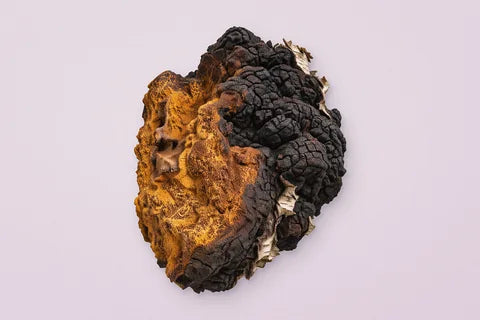
Somewhere on the trunk of an old birch there's a black, cracked lump that looks like it lived through a fire. That's Chaga. People take it because it supports overall wellness,* and it tastes strong, earthy and bitter, which is our polite wording for it.
We'd put it in coffee or tea, at any hour. Our Chaga tincture is made from conks (the lumps) wild-harvested in Vermont.
Woodpecker tea
Drinking it hot is an old habit. During the Second World War a Finnish company sold it in packets, like tea, under the name Tikkatee, which means woodpecker tea. The black conks were gathered, washed, dried and ground to pieces 1 to 4 mm across. You stirred the grains into cold water, heated it almost to a boil and strained it. It started out as a stand-in for real tea and ended up with a following of its own. When it went off the market after the war, people kept asking for it.
We have that from two Finnish mycologists, who put it in a 1983 survey of where their country's bracket fungi grow, as "a curiosity". The name Chaga comes from further east. It's a word from Komi, a small language in the far northeast of Europe, and it reached everyone else by way of Russian. People in northern Asia and northeastern Europe have been picking the stuff for hundreds of years.
How a birch ends up with one
It gets in through a wound, often the stub of a big branch that broke or was sawn off. The fungus, Inonotus obliquus, rots the wood from the inside, the bark swells and cracks, and eventually a conk pushes out. The Maine Forest Service says that can take as little as five years and may take much longer.
Outside, the conk is rough and black enough to pass for charcoal. Break it and it's light brown inside. The tree doesn't come out of it well. Above and below the conk the wood is stained and decaying, and a trunk is more likely to snap there. The Finnish survey blames it for silver birch's bad name as a park tree.
How hard it is to find
Researchers from New Hampshire checked 2,611 birches in the White Mountain National Forest, and fewer than 4 in 100 had Chaga. The ones that did were spread all over the forest but tended to stand near each other, so if you ever find one, look around. Yellow birch had it more often than the other birches, and it was likelier where the trees were older, thicker and higher up the mountain.
Birch is by far the usual host. Now and then it's on beech or hophornbeam in Maine, and on alder in Finland and Estonia.
Ours comes off birch trees in Vermont, brought in by an expert forager we work closely with. Chaga and Turkey Tail are our two wild ones. The sourcing page lists where all eight come from.
Tea or tincture
If you get hold of a conk, you can still do it the Finnish way, and what you get is a water extract. Chaga has fat-loving compounds as well. A lab in Estonia measured two of the better known ones, betulin and inotodiol, in conks taken from birch trees.
So we begin with alcohol, cool and under vacuum, for what water leaves behind, and only then go to hot water for the beta-glucans (here's how that works). Every 1 mL serving starts from 454 mg of dried Chaga (it's a pound to the liter). The usual range is 1 to 3 mL a day. If even coffee doesn't cover it for you, swallow it straight and have some orange juice or lemonade right behind it.
We like it in rotation with Turkey Tail and Maitake over the week, which also gives your tongue a few days off.
Oxalates and your kidneys
Chaga is naturally high in oxalates. Plenty of ordinary food has some, and in large amounts oxalates can settle in the kidneys as crystals.
Serious kidney injury has been reported in people who took several grams of Chaga powder every day for months or years.
Please stay with the amount on the bottle, for this and for any supplement. If you have kidney problems, have ever had kidney stones or are on a low-oxalate diet, ask your doctor before you take Chaga. Do the same if you're pregnant, nursing or taking medication.
Nearly all of the research on Chaga so far is in cells and animals, and people have hardly been studied.
Questions
Is Chaga a mushroom?
It's a fungus, and the part that's harvested is the conk. There's no cap and no stem, so it won't look like any mushroom you've had on a plate.
Can I get it without the taste?
Our capsules come in Lion's Mane and Cordyceps only, so with Chaga it's drops, and a strong cup of coffee is the place to hide them.
Should I start with this one?
When somebody can't decide, it's the one we point them to. "Want it all? Chaga is your friend" is how we put it in our guide to picking a mushroom. The smallest bottle of the tincture is about 30 servings, and the measuring is easy (here's how).
Sources
- Niemelä T, Kotiranta H. Polypore survey of Finland 3. The genera Coltricia, Inonotopsis, Inonotus and Onnia. Karstenia 23:15-25, 1983. doi:10.29203/ka.1983.219
- Maine Forest Service. Chaga/Cinder Conk (Inonotus obliquus). Forest Health and Monitoring fact sheet, revised 2023. maine.gov
- Brydon-Williams R, Munck IA, Asbjornsen H. Incidence and ecology of the chaga fungus (Inonotus obliquus) in hardwood New England-Acadian forests. Canadian Journal of Forest Research 51(1):122-131, 2021. doi:10.1139/cjfr-2020-0144
- Drenkhan R, Kaldmäe H, Silm M, Adamson K, Bleive U, Aluvee A, Erik M, Raal A. Comparative Analyses of Bioactive Compounds in Inonotus obliquus Conks Growing on Alnus and Betula. Biomolecules 12(9):1178, 2022. doi:10.3390/biom12091178
- Lee S, Lee HY, Park Y, Ko EJ, Ban TH, Chung BH, Lee HS, Yang CW. Development of End Stage Renal Disease after Long-Term Ingestion of Chaga Mushroom: Case Report and Review of Literature. Journal of Korean Medical Science 35(19):e122, 2020. doi:10.3346/jkms.2020.35.e122
- Kwon O, Kim Y, Paek JH, Park WY, Han S, Sin H, Jin K. Chaga mushroom-induced oxalate nephropathy that clinically manifested as nephrotic syndrome: A case report. Medicine (Baltimore) 101(10):e28997, 2022. doi:10.1097/MD.0000000000028997
*These statements have not been evaluated by the Food and Drug Administration. This product is not intended to diagnose, treat, cure, or prevent any disease.
*These statements have not been evaluated by the Food and Drug Administration. This product is not intended to diagnose, treat, cure, or prevent any disease.
The finder asks what you're after and picks a mushroom. Find your mushroom


