Reishi Ganoderma lingzhi
Why Reishi Is So Bitter, and How We Take It
In this article
Our way with Reishi is 1 mL stirred into a cup of chamomile tea, in the evening. Reishi helps you relax and unwind.* It's also bitter, and since we add nothing to the tincture to hide that, the tea has a job to do.
Where the bitter comes from
Blame the triterpenic acids. A 2016 study compared two strains that a Belgian company sold under one name. One of them turned out to be Ganoderma lucidum, the European species, and the other was Ganoderma lingzhi from East Asia, the species we use. In ethanol the G. lingzhi gave up far more triterpenic acids, and the authors say those are what makes the mushroom, and the extract, bitter.
So the taste and the alcohol step go together. We run cool alcohol under vacuum through the dried Reishi first and hot water second, because water alone or alcohol alone would leave a lot of it behind (the whole process is here). The two extracts are combined and brought down to a liter per pound of dried mushroom, which puts 454 mg of dried Reishi behind each 1 mL serving.
Getting it down
If tea isn't your thing, take it straight and follow it right away with coffee, orange juice or lemonade. Citrus does a good job on both the bitterness and the alcohol. Cold helps as well, if you ask the people who keep theirs in the fridge. Whatever you do, shake it first.
The usual range is 1 to 3 mL a day, so a 1 oz bottle runs about a month at the low end and the 4 oz about four. We don't make a Reishi without alcohol. Talk to your healthcare professional before you start if you're pregnant, nursing or taking medication.
For a daytime partner we like Shiitake, which tastes like something you'd put on rice. Shiitake every day and Reishi in the evening is the pairing we call The Balanced Life, and the Shiitake guide covers that half of it.
A name that wandered off
Reishi is what it's called in Japan, and in China it's lingzhi. The Latin has had a rougher time. Ganoderma lucidum was named from a fungus found in England. In 1907 the same name was given to specimens from Guizhou, in China, and it stayed on the East Asian mushroom for about a hundred years.
It's still on plenty of packages. For a 2018 paper, researchers in Florida and Minnesota bought 20 finished Reishi products and 17 grow-your-own kits, nearly all labeled G. lucidum, and read their DNA. True G. lucidum turned up in one of the kits and in none of the products. Of the 14 products that gave a clear sequence, 13 were G. lingzhi. Four of the kits held Ganoderma sessile, an American mushroom.
Ours is Ganoderma lingzhi. A 2023 paper from Beijing argues that the right name for it is the older Ganoderma sichuanense, so everybody may be printing new labels before long. The muddle is also a reason to go easy on the studies you read about. Most Reishi research is in cells and animals, trials in healthy adults are few, and a paper that says G. lucidum could be about either mushroom.
First grown in 1959
The 2023 paper also says the use of Ganoderma in China goes back about 6,800 years. Growing it on purpose took until 1959, when Zhuang Deng, assistant to her father, Professor Shu-Chün Teng, raised the first fruiting bodies in Beijing. One of them is still in the collection there. When the paper's authors went to read its DNA, other fungi had moved in on the surface, and any grower will know how that feels.
Ours is grown indoors on hardwood by long-term friends in Arizona, and we extract the whole fruiting body, never mycelium grown on grain. Where our other mushrooms come from is on the sourcing page.
The ones in American woods
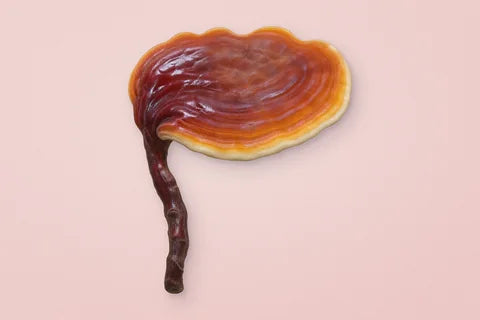
Ganoderma means shiny skin, and on the varnished ones you can see why. The caps look shellacked, in reds, oranges, yellows and browns, and the pore surface underneath bruises brown. They're picky about wood. A species that likes hardwood rarely turns up on a conifer.
In the Northeast, look for the hemlock varnish shelf, Ganoderma tsugae, which usually grows on eastern hemlock. G. curtisii, on hardwoods, and G. sessile are both widespread east of the Rockies. As for the real G. lucidum, mycologist Michael Kuo knows it in this country only from northern California and Utah, where it probably escaped from somebody's grow.
Or leave the looking to somebody else and get our Reishi tincture. Measuring it and storing it are covered in how to take a tincture.
Sources
- Hennicke F, Cheikh-Ali Z, Liebisch T, Maciá-Vicente JG, Bode HB, Piepenbring M. Distinguishing commercially grown Ganoderma lucidum from Ganoderma lingzhi from Europe and East Asia on the basis of morphology, molecular phylogeny, and triterpenic acid profiles. Phytochemistry 127:29-37, 2016. doi:10.1016/j.phytochem.2016.03.012
- Loyd AL, Richter BS, Jusino MA, Truong C, Smith ME, Blanchette RA, Smith JA. Identifying the "Mushroom of Immortality": Assessing the Ganoderma Species Composition in Commercial Reishi Products. Frontiers in Microbiology 9:1557, 2018. doi:10.3389/fmicb.2018.01557
- Du Z, Li Y, Wang XC, Wang K, Yao YJ. Re-Examination of the Holotype of Ganoderma sichuanense (Ganodermataceae, Polyporales) and a Clarification of the Identity of Chinese Cultivated Lingzhi. Journal of Fungi 9(3):323, 2023. doi:10.3390/jof9030323
- Kuo M. The genus Ganoderma. MushroomExpert.Com, 2019. mushroomexpert.com
- Emberger G. Ganoderma tsugae. Fungi on Wood, MushroomExpert.Com, 2025. mushroomexpert.com/fungionwood
*These statements have not been evaluated by the Food and Drug Administration. This product is not intended to diagnose, treat, cure, or prevent any disease.
*These statements have not been evaluated by the Food and Drug Administration. This product is not intended to diagnose, treat, cure, or prevent any disease.
The finder asks what you're after and picks a mushroom. Find your mushroom