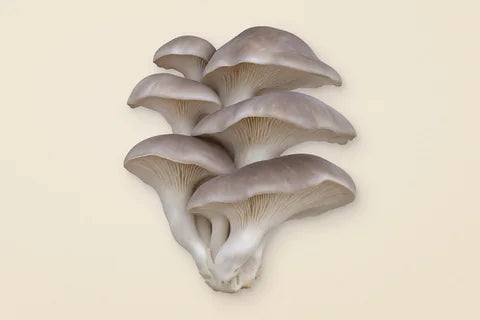
Oyster Pleurotus ostreatus
Oyster Mushrooms Are Mild, Unless You're a Worm
In this article
Start with Oyster if you're not sure you like mushrooms. Our Oyster tincture is delicate and a little sweet, and a serving (1 mL) goes down easily in a cup of broth. Like Turkey Tail, Maitake and Shiitake, it supports a healthy immune system.* Of the four we'd call it the gentlest on the tongue.
That's the polite side of it. On a dead tree the same mushroom lays ambushes.
The lollipops
Pleurotus ostreatus lives on dying hardwood, and there's very little nitrogen in wood like that. Along its threads the fungus grows tiny shapes like lollipops. A nematode (a tiny roundworm) that bumps into one is paralyzed within minutes.
In 2023 a research team worked out how. They made about 12,000 mutants and found 13 that could no longer stop a worm, and every one of the 13 was missing its lollipops. What the lollipops hold is 3-octanone. The paper calls the arrangement a "nerve gas in a lollipop," which sounds alarming until you learn that 3-octanone is also an ordinary part of the smell of fresh mushrooms. You've breathed it in the produce aisle. To drop a worm with it in the lab they needed a concentration over 50%.
Why the fungus bothers is still an open question. The worms may be a meal. Or it may be looking after itself, because some of the nematodes in rotting wood pierce fungal threads and drink the insides. Neither has any bearing on what you get from the tincture.
Quick to grow, fussy about air
Oysters will grow on straw. Cornell's growing guide gives them 14 to 28 days to work through it, and on sawdust only 10 to 20, where Shiitake needs 42 to 84. One count of the world's mushroom crop for 2018-19 puts this species at 16%, behind Shiitake and wood ear and ahead of the white button.
They won't put up with stale air. Cornell says to keep the carbon dioxide in an oyster room under 800 ppm, lower than for most species, because when it builds up you get long stems with little caps on top. They're fragile once they're picked, too. Those torn edges on the ones at the supermarket come from handling.
Ours are grown from start to finish by local growers in Kennett Square, Pennsylvania, the same town our Shiitake comes from. We extract whole fruiting bodies and never mycelium on grain.
Which oyster is which
The wild one likes the cold. In North America P. ostreatus comes up between October and early April, in shelves on dead logs and living trees, mostly hardwoods. The cap is pale to dark brown and shaped like a fan, the gills are whitish and run down whatever stem there is, and the spore print is white to lilac. The mycologist Michael Kuo often finds the gills full of black beetles. He also had a go at describing the smell, and the closest he could get was "oyster mushroom smell." (Please don't pick dinner off this paragraph. Go out with somebody who knows.)
What a store sells as oyster may be a cousin. When grow rooms warm up in summer, some farms switch to the phoenix oyster, Pleurotus pulmonarius, and king oysters are another species again. The one in our bottle is P. ostreatus.
Inside a dried oyster mushroom
About a quarter of it is beta-glucan. A survey of 39 mushroom species measured 24% of the dry weight in this one, and getting at that is the job of the hot-water half of our extraction.
It's also high in ergothioneine, a sulfur compound that fungi make and people can't. A small 2026 study bought mushrooms off the shelf and found about 0.51 mg per gram in dried oysters. That's three times what it found in dried Shiitake and over 25 times what it found in dried white buttons, and of the mushrooms it tested only porcini had more. Frying and pressure cooking didn't destroy it, so you can stop worrying about the skillet. Those numbers are for the whole dried mushroom, from three to six samples of each.
There isn't much research in people yet, and the studies that exist are small.
Taking it
If you're cooking, put it in a broth or a stir-fry. (We think Oyster and Shiitake go together, and we like the fresh ones in the same pan.) If you take it straight, have a drink ready, because it's still a tincture and it still has alcohol in it. The usual range is 1 to 3 mL a day, and the page on taking tinctures has the practical stuff. Talk to your healthcare professional before you start if you're pregnant, nursing or taking medication.
A serving starts out as 454 mg of dried oyster mushroom (4,540 mg fresh). How a mushroom ends up as a liquid is in our dual extraction article.
The Oyster tincture comes in 1, 2 and 4 oz. A 1 oz bottle is a 30-day supply at 1 mL a day, and a subscription saves you 13%.
Questions
Is there any shellfish in it?
No, only in the name. The ingredients are oyster mushroom fruiting bodies, distilled water and alcohol.
Isn't Oyster the vitamin D mushroom?
It can be, if you put it under UV light. With the same lamp, whole oysters made more than twice as much vitamin D2 as Shiitake. Mushrooms that haven't been under one have very little, and USDA lists fresh oysters at less than 1 microgram per 100 g. We don't promise any in the tincture.
Sources
- Lee CH, et al. A carnivorous mushroom paralyzes and kills nematodes via a volatile ketone. Science Advances, 2023. doi:10.1126/sciadv.ade4809
- Guo Y, et al. Disentangling the Tissue-Specific Variations of Volatile Flavor Profiles of the Lentinula edodes Fruiting Body. Foods, 2024. doi:10.3390/foods13010086
- Cornell Small Farms Program. Methods of Commercial Mushroom Cultivation in the Northeastern United States: Seven Stages of Cultivation. Cornell University. smallfarms.cornell.edu
- Singh M, Kamal S, Sharma VP. Status and trends in world mushroom production-III. Mushroom Research, 2020. doi:10.36036/mr.29.2.2020.113703
- Kuo M. Pleurotus ostreatus. MushroomExpert.Com, 2017. mushroomexpert.com
- Sari M, Prange A, Lelley JI, Hambitzer R. Screening of beta-glucan contents in commercially cultivated and wild growing mushrooms. Food Chemistry, 2017. doi:10.1016/j.foodchem.2016.08.010
- Guthrie C, Hasic S, Gordon H. Interspecies distribution and processing stability of ergothioneine and histidine in commercially available mushrooms. microPublication Biology, 2026. doi:10.17912/micropub.biology.002257
- Cardwell G, Bornman JF, James AP, Black LJ. A Review of Mushrooms as a Potential Source of Dietary Vitamin D. Nutrients, 2018. doi:10.3390/nu10101498
*These statements have not been evaluated by the Food and Drug Administration. This product is not intended to diagnose, treat, cure, or prevent any disease.
*These statements have not been evaluated by the Food and Drug Administration. This product is not intended to diagnose, treat, cure, or prevent any disease.
The finder asks what you're after and picks a mushroom. Find your mushroom