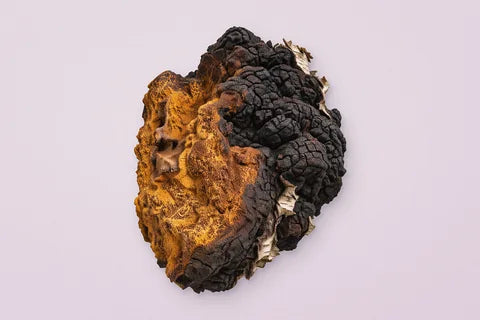
Maitake Grifola frondosa
Maitake Means Dancing Mushroom, but Nobody Knows Who Danced

In this article
If you cook, you'll like Maitake. It's sweet and savory with some umami, and our Maitake tincture goes into broth, soup or a stir-fry. It supports a healthy immune system.* You may know the mushroom as hen of the woods.
Who's dancing
In Japanese mai is dance and take is mushroom. Nobody agrees on who does the dancing. One theory says it's whoever found the mushroom. Others say the frills look like a butterfly fluttering, or like the hem of a dancer's kimono. Wild Maitake was rare, and in the Edo period (1603 to 1868) people who brought one to a feudal lord are said to have been paid its weight in silver, so we lean toward the first theory.
Then the growers got hold of it. They worked on logs and sawdust through the 1970s and took it indoors in the 1980s, with the temperature, the humidity and the carbon dioxide all under control. Today it's in Japanese shops all year, at a price anybody can live with.
The hen under the oak
In American woods, look at the foot of oaks from late summer on. In southern New England the good weeks are usually mid-September to early October. What you're after is a rosette of overlapping caps that can reach 60 cm across, about two feet. It's lavender-gray when young and brownish gray later, so it can disappear into the leaves, all two feet of it. Each cap is only an inch to three wide. Underneath it's white to yellowish, with one to three pores to the millimeter, big enough to see.
Grifola means something intricate or braided, like a fishnet or a woven basket, and frondosa means full of leaves, which is about how it looks.
Once you've found one, remember the tree. It can come up in the same spot year after year, because the fungus lives in the roots and lower trunk and rots them very slowly. A hen at the foot of your oak doesn't necessarily mean the oak is about to come down. And have someone experienced look at any wild mushroom before you eat it.
Two hens
In 2002 a group at Penn State compared the genes of 51 samples, 27 from Asia and 21 from eastern North America among them. The two kinds look alike, and both go by Grifola frondosa. Their genes split so cleanly that the authors took them for separate species. The main strain in American grow rooms at the time grouped with the Asian ones. So the hen your uncle digs out of the leaves and the Maitake in the produce aisle may be no more than cousins.
Ours
Old friends of ours grow it in Pennsylvania, indoors, on hardwood. It isn't a quick crop. In another round of Penn State trials, on oak sawdust with supplements mixed in, the fastest of 23 strains needed 8 weeks to finish a crop. We take only the whole fruiting bodies, dried, and load them by hand into our own stainless steel Soxhlet. (The sourcing page says where our other seven come from.)
Alcohol goes through first, at low temperature, and then hot water for the beta-glucans (why we bother doing it twice). Ten pounds of fresh Maitake make about one pound dried, and a dried pound makes a liter, so your 1 mL serving stands for 4,540 mg of fresh mushroom, or 454 mg dried. That's what we mean by 10:1.
In the kitchen
Fresh Maitake doesn't need a knife. Tear the cluster into small pieces with your hands and it's ready. Japanese cooks fry it as tempura to go on soba or udon, cook it into rice with chicken, wrap it in thin slices of pork belly, or drop it in a hotpot. Cream sauce over pasta works too.
For the nights you don't have any, stir a serving of the tincture into a bowl of soup or broth, or over a stir-fry. You can also take it straight and drink something after it, since there's alcohol in it, or put it in coffee or tea. The usual range is 1 to 3 mL a day, and at 1 mL a 1 oz bottle is about a month's worth. There's more in how to take a tincture.
We like Maitake in rotation with Turkey Tail and Chaga through the week.
Most of the research on it so far is in cells and animals. Talk to your healthcare professional before you start if you're pregnant, nursing or taking medication.
Questions
Is it the same as chicken of the woods?
No, though you can find either one on an oak. Chicken of the woods, Laetiporus sulphureus, is bright orange on top when it's fresh and sulphur yellow underneath.
How do I choose between this, Shiitake, Oyster and Turkey Tail?
By taste. They each support a healthy immune system,* and our beginner's guide says what to expect from all four. The gentlest is Oyster. If you want umami without the garlic, it's this one.
Sources
- Nippon.com. Maitake: Mushrooms with an Aroma and Texture to Make You Dance. Nippon Communications Foundation, 2026. nippon.com
- Emberger G. Fungi on Wood, MushroomExpert.Com, 2025: Grifola frondosa and Laetiporus sulphureus.
- Brazee NJ. Root and butt rot caused by Grifola frondosa (hen of the woods). UMass Extension Landscape, Nursery and Urban Forestry Program, 2023. umass.edu
- Shen Q, Geiser DM, Royse DJ. Molecular phylogenetic analysis of Grifola frondosa (maitake) reveals a species partition separating eastern North American and Asian isolates. Mycologia 94(3):472-482, 2002. PubMed 21156518
- Shen Q, Royse DJ. Effects of genotypes of maitake (Grifola frondosa) on biological efficiency, quality and crop cycle time. Applied Microbiology and Biotechnology 58(2):178-182, 2002. doi:10.1007/s00253-001-0875-6
*These statements have not been evaluated by the Food and Drug Administration. This product is not intended to diagnose, treat, cure, or prevent any disease.
*These statements have not been evaluated by the Food and Drug Administration. This product is not intended to diagnose, treat, cure, or prevent any disease.
The finder asks what you're after and picks a mushroom. Find your mushroom