Turkey Tail Trametes versicolor
How to Tell a Real Turkey Tail Mushroom
In this article
Turn it over. A real Turkey Tail (Trametes versicolor) has a white to yellowish underside full of tiny pores. The false one is smooth.
People take Turkey Tail because it supports a healthy immune system.* It tastes plain and earthy, and our Turkey Tail tincture goes into coffee or tea at any time of day. Nobody farms ours. It's picked wild in the Northeast, and the signs that give it away are easy enough to check yourself.
Four things to check
- Underneath, there are 3 to 5 pores to the millimeter, small enough that at a glance the surface looks blank. Hold it close, or bring a hand lens.
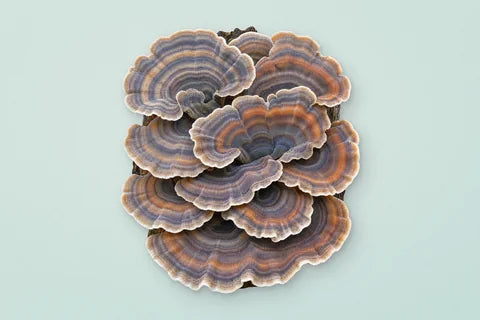
- On top you want bands of clearly different colors, which can be yellowish, orange, gray, blue, black or reddish brown. Velvety bands alternate with nearly bald ones, and the outermost band is usually pale.
- It's thin. A cap is 2.5 to 8 cm wide (1 to 3 inches) and only 1 to 3 mm thick.
- It grows on dead or dying hardwood and hardly ever on conifers, in overlapping shelves or, on a horizontal log, in rosettes.
Of all the mushrooms named after birds, this is the one that looks the part. Trametes means "one who is thin" and versicolor means "of various colors", so whoever picked the Latin was paying attention too.
The look-alikes
The false turkey tail, Stereum ostrea, has the bands and the fuzz and grows on the same kind of wood. Flip it and you won't find a pore anywhere, because it's a crust fungus. Algae like to grow on it. Tom Volk of the University of Wisconsin-La Crosse wrote that it's actually hard to find one without some green.
The others do have pores, so look at the rest of the mushroom:
- Trametes pubescens is creamy or yellowish all over, with faint bands or none.
- Trametes hirsuta can be up to 2 cm thick and is densely hairy, often gray with a brown edge. It varies a lot, so don't be surprised if you can't settle it.
- The violet-toothed polypore, Trichaptum biforme, is purplish underneath when it's young. As it ages the pores break down into little teeth.
What it's doing on that log
Turkey Tail is a white-rot fungus. It eats the lignin, the brown stuff that stiffens wood, and leaves the pale cellulose behind. Gary Emberger, who keeps the Fungi on Wood pages, thinks it may be the most common decomposer of hardwoods in North America. The caps hold up well and some last through the winter, so you can find them in almost any season.
That appetite has made it one of the most studied white-rot fungi there is. A 2021 review goes through the jobs industry would like to give it, such as using up plant waste, cleaning wastewater and making biofuel. One of its enzymes, laccase, is good at taking lignin apart, and a lot of that work is about putting it to use.
Ours, and how we take it
Expert foragers we work closely with collect it for us in several Northeastern states. Chaga is the one other mushroom we get from the wild. The other six are cultivated, and the sourcing page says where.
There isn't enough on a cap that thin to make a meal of, so we extract it. Our hot-water step is the one aimed at its beta-glucans. It comes after a gentle alcohol run, and the order has its reasons. A pound of dried Turkey Tail goes into every liter, so a 1 mL serving stands for 454 mg of it.
The usual range is 1 to 3 mL a day, in a drink or straight with a drink right behind it. Rotated through the week with Chaga and Maitake, it's a third of what our beginner's guide calls The Wellness Enthusiast. Check with your healthcare professional first if you're pregnant, nursing or taking medication.
How much is known
In healthy people, not a lot yet. In one trial from Hong Kong, published in 2004, 100 healthy volunteers took Turkey Tail and a plant called danshen in the same capsules for four months, and a placebo for another four. With the two mixed together, nobody can say which of them did what.
Questions
Why doesn't mine look like the photos?
The colors depend on the genetics of that particular fungus and on where it's growing. Some are mostly brown, and others run gray or even bluish. Go by the pores and the velvet.
Can I pick my own?
Sure, after you've been out a few times with somebody who knows it. A local mushroom club is the place to start. If you'd rather leave it to our foragers, there's the tincture. A 1 oz bottle is about 30 servings, and how to take a tincture covers the rest.
Sources
- Emberger G. Fungi on Wood, MushroomExpert.Com, 2025: Trametes versicolor, Trametes hirsuta, Trametes pubescens, Trichaptum biforme.
- Kuo M. Stereum ostrea. MushroomExpert.Com, 2008. mushroomexpert.com
- Volk TJ. Fungus of the Month, University of Wisconsin-La Crosse: Trametes versicolor (August 1997) and Stereum ostrea (November 2000).
- Tišma M, Žnidaršič-Plazl P, Šelo G, Tolj I, Šperanda M, Bucić-Kojić A, Planinić M. Trametes versicolor in lignocellulose-based bioeconomy: State of the art, challenges and opportunities. Bioresource Technology 330:124997, 2021. doi:10.1016/j.biortech.2021.124997
- Wong CK, Tse PS, Wong EL, Leung PC, Fung KP, Lam CW. Immunomodulatory effects of yun zhi and danshen capsules in health subjects: a randomized, double-blind, placebo-controlled, crossover study. International Immunopharmacology 4(2):201-211, 2004. doi:10.1016/j.intimp.2003.12.003
*These statements have not been evaluated by the Food and Drug Administration. This product is not intended to diagnose, treat, cure, or prevent any disease.
*These statements have not been evaluated by the Food and Drug Administration. This product is not intended to diagnose, treat, cure, or prevent any disease.
The finder asks what you're after and picks a mushroom. Find your mushroom