Cordyceps Cordyceps militaris
The Orange Cordyceps and the Expensive One
In this article
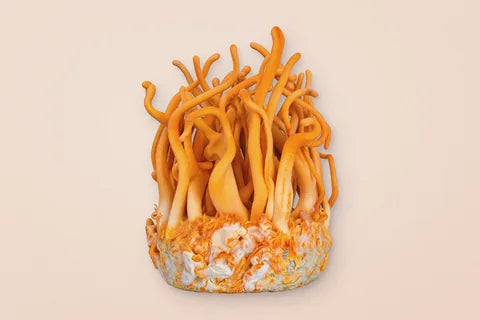
The famous Cordyceps, the one that grows out of a caterpillar on the Tibetan Plateau and costs as much as a car by the kilo, is a different species from ours. Ours is Cordyceps militaris, a small orange club that's grown indoors.
Cordyceps supports energy and stamina,* and we like it before a workout or when the afternoon dips. The Cordyceps tincture tastes plain and earthy. A serving is 1 mL, and people usually take 1 to 3 mL a day, in a drink or with one right behind it.
The bug that wouldn't rot
Out in the wild C. militaris grows on insects, mostly the buried larvae and pupae of moths and butterflies. All you see from above is the orange club, a couple of inches tall. Michael Kuo, who runs MushroomExpert.Com, calls it "pretty much the coolest mushroom ever" and admits that the one time he found it he mistook it for something else and picked it without digging up the bug. It's widespread, through the Americas, Europe and Asia.
In 1950 a group writing in Nature gave an odd reason for studying it. The insect tissue bound up in the fungus resists decay. From cultures of the fungus they isolated a new compound, cordycepin. It's an almost exact copy of adenosine, one of the building blocks in your own cells, with a single oxygen atom missing. What the body does with it is a longer story, and it's in our piece on cordycepin.
The expensive one
Caterpillar fungus is Ophiocordyceps sinensis. In Chinese it's dongchong xiacao, worm in winter and grass in summer, which is a fair summary of its year. It lives on ghost moth larvae in mountain soil, at 3,000 to 5,000 meters, on the Tibetan Plateau and in the Himalayas. Under 200 tons of it are picked a year, nearly all in China, and good specimens have sold for $10,000 to $60,000 a kilogram.
It was called Cordyceps sinensis for a long time, and the two still get mixed up. A big DNA study in 2007 put it in another genus and another family altogether. There isn't enough of the wild one to go around, so fermented mycelium gets sold in its place. China alone has approved more than ten health products that are mostly that.
If you're holding a bottle that only says Cordyceps, look for the Latin name and for the part that was used. We use the fruiting bodies of Cordyceps militaris.
Orange takes light
The color is carotenoids, the family of pigments in carrots, and the fungus won't make much of it in the dark. Plates left in the dark for 20 days in a 2022 study stayed pale, and 12 hours of light turned them yellow-orange.
It has other opinions about being farmed. Korean researchers found that cultures started from a single spore never fruited, and that it took a pair of opposite mating types. A good strain can wear out on you, too. In a 2023 study from Vietnam, three strains fruited badly by the third generation from spores. So we leave it to people who do this for a living. Ours is grown indoors, by professionals in California and Colorado, and we take the orange clubs and nothing else.
Into the bottle
The clubs are dried, loaded by hand into our Soxhlet, and put through two extractions, cool alcohol and then hot water. To make 1 mL we use 454 mg of dried Cordyceps, or 4,540 mg fresh, and a 1 oz bottle holds about thirty of those.
There's cordycepin in the mushroom, and adenosine, polysaccharides, ergosterol and those carotenoids. Beta-glucans are what the hot water is for.
The Cordyceps capsules hold 135 mg of dual extract each, blended back with 375 mg of the fruiting body it came from (post-extraction). You take one a day with water. They have no alcohol and no mushroom taste, and the label says "Supports energy and stamina.*"
Tincture and capsules are both 3rd Party Lab Verified, and certificates of analysis are available on request. Check with your healthcare professional before you start either one if you're pregnant, nursing or taking medication. For the hour of the day, see the best time to take Cordyceps.
What the exercise studies say
Exercise is where most of the human research is, and there isn't much of it. A 2026 review found five exercise studies in healthy people, with 321 participants between them. More than half, 180, were teenage swimmers in one study. Two of the five tested a six-mushroom blend and one a mycelium extract. Some reported gains, but the results don't line up with each other. The reviewers didn't rate a single one as low risk of bias.
One from 2017 gives you the flavor. Twenty-eight young adults took 4 g a day of a blend built on Cordyceps mycelium grown on oats, or a placebo, and a supplement company paid for part of the work. After a week the groups were no different. Ten people went on to three weeks, and oxygen uptake rose more on the blend than on placebo. Time to exhaustion still came out even.
None of that was our tincture. Between Cordyceps and Lion's Mane, go by what you want it for.
Questions
Is it really a mushroom?
Everybody calls it one, us included. Strictly speaking it's an ascomycete, which is a different branch of the fungi from Lion's Mane or Shiitake. The part we use is still the fruiting body.
Can I get it on a schedule?
The tincture, yes, through Subscribe & Save. It comes in 1, 2 and 4 oz bottles, and the product page shows the choices.
Sources
- Kuo M. Cordyceps militaris. MushroomExpert.Com, 2006. mushroomexpert.com
- Cunningham KG, Manson W, Spring FS, Hutchinson SA. Cordycepin, a metabolic product isolated from cultures of Cordyceps militaris (Linn.) Link. Nature 166:949, 1950. doi:10.1038/166949a0
- He Z, Ye M, Wu H, et al. The Conservation Crisis of Ophiocordyceps sinensis: Strategies, Challenges, and Sustainable Future of Artificial Cultivation. Journal of Fungi 11(12):892, 2025. doi:10.3390/jof11120892
- Sung GH, Hywel-Jones NL, Sung JM, Luangsa-ard JJ, Shrestha B, Spatafora JW. Phylogenetic classification of Cordyceps and the clavicipitaceous fungi. Studies in Mycology, 2007. doi:10.3114/sim.2007.57.01
- On growing it: Shrestha B, Han SK, Lee WH, et al. Distribution and in vitro Fruiting of Cordyceps militaris in Korea. Mycobiology, 2005. doi:10.4489/myco.2005.33.4.178. Vu TX, Thai HD, Dinh BT, et al. Effects of MAT1-2 Spore Ratios on Fruiting Body Formation and Degeneration in the Heterothallic Fungus Cordyceps militaris. Journal of Fungi 9(10):971, 2023. doi:10.3390/jof9100971. He R, Zhang L, Lan J, Mei S, Li Y. Cmcrf1, a Putative Zn2Cys6 Fungal Transcription Factor, Is Involved in Conidiation, Carotenoid Production, and Fruiting Body Development in Cordyceps militaris. Biology 11(10):1535, 2022. doi:10.3390/biology11101535
- Jędrejko KJ, Lazur J, Muszyńska B. Cordyceps militaris: An Overview of Its Chemical Constituents in Relation to Biological Activity. Foods 10(11):2634, 2021. doi:10.3390/foods10112634
- Jędrejko M, Jędrejko K, Granda D, Kała K, Pokrywka A, Muszyńska B. Current Evidence of Ergogenic and Post-Exercise Recovery Effects of Dietary Supplementation with Cordyceps militaris in Humans: A Narrative Review. Nutrients 18(5):781, 2026. doi:10.3390/nu18050781
- Hirsch KR, Smith-Ryan AE, Roelofs EJ, Trexler ET, Mock MG. Cordyceps militaris Improves Tolerance to High-Intensity Exercise After Acute and Chronic Supplementation. Journal of Dietary Supplements, 2017. PMC5236007
*These statements have not been evaluated by the Food and Drug Administration. This product is not intended to diagnose, treat, cure, or prevent any disease.
*These statements have not been evaluated by the Food and Drug Administration. This product is not intended to diagnose, treat, cure, or prevent any disease.
The finder asks what you're after and picks a mushroom. Find your mushroom


