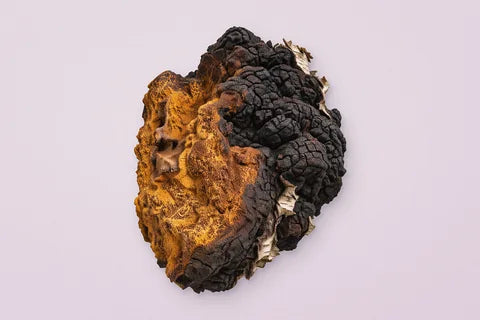
Shiitake Lentinula edodes
You Can Cook With Our Shiitake Tincture
In this article
Our Shiitake tincture supports a healthy immune system,* and it tastes like Shiitake, savory and a little garlicky. A serving is 1 mL, swallowed or stirred into dinner.
Straight, or in the soup
We take ours straight, with coffee, tea or orange juice right behind it to cut the alcohol. The other way is to put it in the food. It's happy in broth or a stir-fry. Finish the bowl, though, because that's where your serving went.
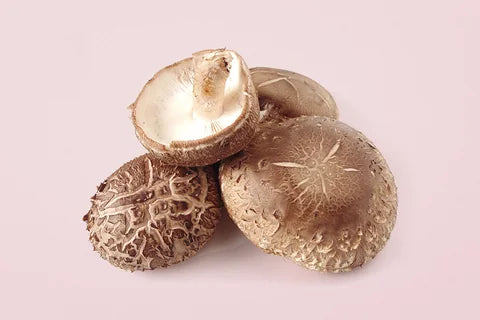
If you have fresh ones, cook those too, with some oyster mushrooms in the pan if you can get them. We think the flavors pair well. The tincture is for the days when dinner is cereal.
The usual range is 1 to 3 mL a day. We like Shiitake every day with Reishi in the evening, and we think it goes with Oyster too. If you've never used a dropper bottle, here's how to take a tincture. Ask your healthcare professional first if you're pregnant, nursing or taking medication.
Where the garlic comes from
Fresh Shiitake smells mostly of 1-octen-3-ol, which goes by the name mushroom alcohol. Dry it and the sulfur compounds come forward, lenthionine among them. They start out as a substance called lentinic acid. Two enzymes take that apart, and after that the chemistry carries on by itself.
Shiitake's relatives do it too. When researchers compared genomes from across the genus, they found that the genes thought to make lenthionine had multiplied there, and they note that these species get described as tasting of cabbage, radish or garlic. One that grows along the Gulf Coast and as far south as Brazil is called Lentinula raphanica, after the radish. Our mushrooms are dried before we extract them, and the garlic note makes it into the bottle.
A mushroom you have to wake up
Shiitake (Lentinula edodes) is a wood rotter, at home on oaks and their relatives. One of those relatives is the shii tree, which is where the Japanese name comes from. In Chinese it's xiang-gu, and in Korean p'yogo.
In one corner of Zhejiang, China, people have farmed it for more than 800 years. The growers there credit Wu Sangong, born in 1130, and a farming book from 1313 already describes the method. You fell a broadleaf tree, cut into the trunk so the spores can get established, and later you tap the trunk to make the mushrooms form. At the peak some 150,000 people worked that way, and it lasted until the middle of the 1900s.
They were on to something with the tapping. Cornell's guide for commercial growers says Shiitake responds to a shock. You can soak a log for 24 hours, as if it had sat through a heavy rain, or put a sawdust block in a cooler for 12 to 24. Jostle a block too early and it fruits before it's ready.
Getting to that point is slow. A log incubates for 6 to 18 months and a block for 42 to 84 days. The blocks go bumpy, which growers call popcorning, and then brown, and wherever two of them touch you get no mushrooms at all. For all that bother it's the most produced edible mushroom in the world.
What "US-grown" can leave out
In a grocery store, fresh produce can be labeled a product of the USA if it was harvested here. A 2024 brief from Vermont Law and Graduate School uses Shiitake to show what that allows. A log can be inoculated and grown out in China, frozen and shipped over, and about a week later somebody in the US is picking mushrooms off it.
Local growers in Kennett Square, Pennsylvania grow ours from start to finish. Every stage happens in the US, the substrate included. Our oyster mushrooms come from the same town. We don't extract mycelium on grain, and if you're wondering what that is, there's an article on fruiting body and mycelium.
Lentinan, and what's in the stems
The compound with the famous name is lentinan. It's a beta-glucan, a long chain of sugar units, and in water three of those chains wind around each other like a rope. We run the dried mushroom through cool alcohol under vacuum and then through hot water, and the hot water is there for the beta-glucans. It comes to 454 mg of dried Shiitake for each mL in the bottle, or 4,540 mg fresh (here's the arithmetic).
If you cook fresh ones, keep the stems. One lab measured about 20% beta-glucan in dried Shiitake caps and about 25% in the stems. They're chewy, so put them in the stock.
Studies in people are few and small. In one at the University of Florida, 52 healthy adults ate 5 or 10 grams of dried Shiitake a day for four weeks, and the researchers reported changes in immune cells in the blood and in an immune protein in saliva. All 52 ate the mushroom whole, with nobody going without for comparison, so it can't tell you much about an extract.
Questions
Raw Shiitake gave me a rash. Can I take this?
Ask your healthcare professional before you try it. Some people react to Shiitake that's raw or undercooked, and the suspect is lentinan.
How long does a bottle last?
About 30 days for the 1 oz at 1 mL a day. The Shiitake tincture also comes in 2 and 4 oz, and if it turns into a habit, Subscribe & Save takes 13% off a tincture.
Sources
- Guo Y, et al. Disentangling the Tissue-Specific Variations of Volatile Flavor Profiles of the Lentinula edodes Fruiting Body. Foods, 2024. doi:10.3390/foods13010086
- Sierra-Patev S, et al. A global phylogenomic analysis of the shiitake genus Lentinula. PNAS, 2023. doi:10.1073/pnas.2214076120
- Tan Q, et al. China's Xianggu (Lentinula edodes) cultivation techniques and industrial development. Panfungi, 2026. doi:10.48130/panfungi-0026-0003
- Cornell Small Farms Program. Methods of Commercial Mushroom Cultivation in the Northeastern United States: Seven Stages of Cultivation. Cornell University. smallfarms.cornell.edu
- Center for Agriculture and Food Systems. What is Country of Origin Labeling? Vermont Law and Graduate School, 2024. labelsunwrapped.org
- Nandi LG, et al. Properties of aqueous solutions of lentinan in the absence and presence of zwitterionic surfactants. Carbohydrate Polymers, 2013. doi:10.1016/j.carbpol.2013.04.053
- Sari M, Prange A, Lelley JI, Hambitzer R. Screening of beta-glucan contents in commercially cultivated and wild growing mushrooms. Food Chemistry, 2017. doi:10.1016/j.foodchem.2016.08.010
- Dai X, et al. Consuming Lentinula edodes (Shiitake) Mushrooms Daily Improves Human Immunity: A Randomized Dietary Intervention in Healthy Young Adults. Journal of the American College of Nutrition, 2015. doi:10.1080/07315724.2014.950391
*These statements have not been evaluated by the Food and Drug Administration. This product is not intended to diagnose, treat, cure, or prevent any disease.
*These statements have not been evaluated by the Food and Drug Administration. This product is not intended to diagnose, treat, cure, or prevent any disease.
The finder asks what you're after and picks a mushroom. Find your mushroom