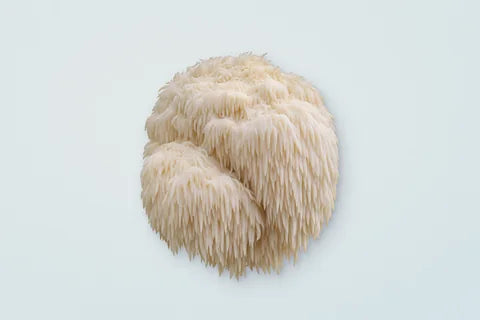
Lion's Mane Hericium erinaceus
Which Half of Lion's Mane Has the Hericenones
In this article
If a Lion's Mane label talks about erinacines, the next word to look for is mycelium. If it talks about hericenones, look for fruiting body. The fungus makes the two in different places, and a product can't hold what wasn't in the part it was made from.
Ours is made from fruiting bodies. The Lion's Mane tincture supports focus and mental clarity,* it tastes clearly of mushroom, and we like a serving (1 mL) in the morning coffee. The capsules skip the taste and the alcohol, and their label says "Supports focus and nerve health.*"
One name, cut in half
The mushroom is Hericium erinaceus, and the chemists who named these compounds used up both words. Hericenones are what they found in the mushroom. Erinacines came out of the mycelium, the mat of threads it grows from. More than 200 small molecules have been isolated from Lion's Mane by now, but those two families take up most of the conversation.
A hericenone is a small ring with an oily chain attached, and 24 natural ones have been described. Hericenes are their close relatives. Erinacines are built on a different skeleton altogether, and erinacine A is the one studied most.
Beta-glucans are something else again. They're long chains of glucose, and a lot of other mushrooms make them too.
The Pavia measurements
In 2019 a group at the University of Pavia took a single strain collected in Tuscany and measured it four ways: the mycelium, the baby mushroom, a mushroom from the wild, and mushrooms they had raised from that strain in a greenhouse.
| What they measured | Erinacine A (µg per gram) | Hericenone C (µg per gram) | Hericenes (size of the peaks) |
|---|---|---|---|
| Mycelium | 105 | None found | 684 |
| Baby mushroom | None found | None found | 557 |
| Wild mushroom | None found | 760 | 627 |
| Cultivated mushroom | None found | 1,560 | 1,685 |
The last column is peak area on the lab's chart, so compare it only with itself. The baby mushroom was weighed fresh and the others dry, so its figures run low.
Hericenes turned up at every stage, and the wild mushroom had slightly fewer of them than the mycelium did. The cultivated mushroom had about two and a half times the mycelium's hericenes and twice the wild one's hericenone C. The authors think the fungus may make hericenone C out of hericene A by oxidizing it. They call that a hypothesis, and all of this is one strain.
In 2025 another group came at it from the genes. The ones that build erinacines were turned down in the mushroom, and none of the four erinacines they looked for could be found there. The mycelium made plenty, and what it was fed made a difference. One of the four came out about a hundred times higher in one broth than in the other. (All of the authors have ties to a company that makes fungal supplements. None of its products were in the study.)
On the shelf it's all over the place
In 2026 chemists at an ingredient supplier published a way to measure these compounds, and tried it on raw material and on products bought in stores in Iowa. The one mycelium product with enough to measure held about 0.2 mg of erinacine A per gram and hardly any hericenones. The mushroom samples had no detectable erinacine A. Their hericenones and hericenes ran anywhere between 0.005 and 1 mg per gram, depending on the compound and the sample, and in some of what they tested most of the compounds were too low to measure.
So "fruiting body" on a label tells you what could be in there. How much is another matter, and the authors point to the strain and to when it was picked. We don't print figures for single compounds ourselves. Our Lion's Mane has hericenones and hericenes in amounts we can verify, so ask us for the certificate if you want to see them.
What dissolves in what
Beta-glucans come out in hot water, which is how labs usually do it. A 2025 review says the mushroom holds more total polysaccharide than the mycelium, and that the commonest kind in Lion's Mane is a beta-glucan with 1,3 and 1,6 links.
Hericenones, hericenes and erinacines want alcohol. The Pavia group used 70% ethanol at 50 °C, and the 2026 chemists used straight ethanol and an ultrasonic bath. Water by itself would leave much of the oily stuff behind, and alcohol by itself would leave much of the beta-glucan. So our mushrooms go through twice, cool alcohol under vacuum first and hot water second, and you can follow a run start to finish in our dual extraction article.
About nerve growth factor
Both families got noticed because of it. The group that named them reported that hericenones C to H and erinacines A to I raise production of nerve growth factor, a protein, in lab work. For hericenones the record is mixed. In 2008 a different lab found that an ethanol extract of Lion's Mane did it in human cells in a dish while hericenones C, D and E on their own didn't, and decided that something else in the extract was responsible.
As far as we know, nobody has measured if any of these compounds reach the brain in people, or when. The authors of a 2025 trial list that as work still to do. What small trials in healthy people did find is in our Lion's Mane guide.
If you're weighing up which half of the fungus you want, fruiting body vs mycelium is the place to start. If it's the mushroom, that's what our Lion's Mane tincture is made from, and people usually take 1 to 3 mL of it a day. Talk to your healthcare professional first if you're pregnant, nursing or taking medication.
Sources
- Wang J, Wu J, Yamaguchi R, et al. Uncovering Hericenones from the Fruiting Bodies of Hericium erinaceus through Interdisciplinary Collaboration. Journal of Natural Products, 2025. doi:10.1021/acs.jnatprod.4c01018
- Othman A, Amen Y, Shimizu K. Hericenones From Hericium erinaceus (Bull.) Pers.: A Scoping Review of Structural Diversity and Health Benefits. Chemistry & Biodiversity, 2026. doi:10.1002/cbdv.202502560
- Corana F, Cesaroni V, Mannucci B, et al. Array of Metabolites in Italian Hericium erinaceus Mycelium, Primordium, and Sporophore. Molecules 24(19):3511, 2019. doi:10.3390/molecules24193511
- Doar E, Meyer KW, Bair ZJ, et al. Influences of substrate and tissue type on erinacine production and biosynthetic gene expression in Hericium erinaceus. Fungal Biology and Biotechnology, 2025. doi:10.1186/s40694-025-00194-9
- Tang Y, Kahraman O, Goos AJ, Fields C. Simultaneous UHPLC-UV Determination of Hericenones, Hericenes, Erinacines and Ergosterol in Hericium erinaceus Raw Materials or Products. Molecules, 2026. doi:10.3390/molecules31030569
- Sun N, Li C, Liang W, et al. Extraction, Structural Characterization and Biological Activities of Polysaccharides Derived From Hericium erinaceus. Food Science & Nutrition, 2025. doi:10.1002/fsn3.71275
- Mori K, Obara Y, Hirota M, et al. Nerve growth factor-inducing activity of Hericium erinaceus... Biological and Pharmaceutical Bulletin 31(9):1727-1732, 2008. doi:10.1248/bpb.31.1727
- Surendran G, Saye J, Binti Mohd Jalil S, et al. Acute effects of a standardised extract of Hericium erinaceus (Lion's Mane mushroom) on cognition and mood in healthy younger adults: a double-blind randomised placebo-controlled study. Frontiers in Nutrition, 2025. doi:10.3389/fnut.2025.1405796
*These statements have not been evaluated by the Food and Drug Administration. This product is not intended to diagnose, treat, cure, or prevent any disease.
*These statements have not been evaluated by the Food and Drug Administration. This product is not intended to diagnose, treat, cure, or prevent any disease.
The finder asks what you're after and picks a mushroom. Find your mushroom